
Main Courses
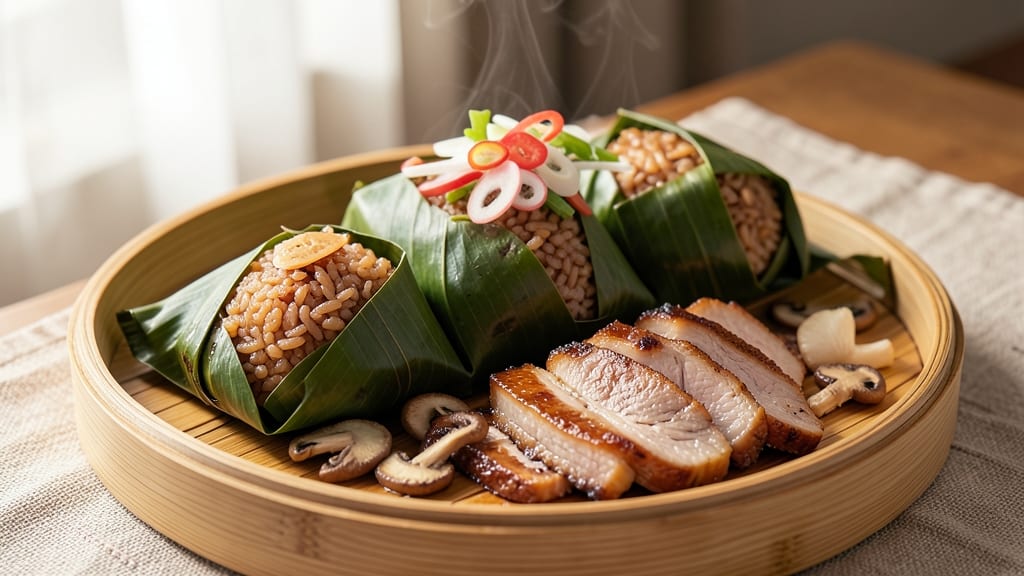
This Chinese sticky rice wrapped leaves recipe delivers the essence of Dragon Boat Festival traditions in every bite. The gluten-free filling combines fragrant glutinous rice with savory pork, mushrooms, and aromatic herbs, all encased in tender bamboo leaves.
What makes this dish special is the delicate balance of textures—silky rice, crisp edges from steaming, and the earthy aroma of fresh leaves. The process begins with soaking the leaves to create pliable wrappers, then carefully layering the rice and filling before tying them into neat bundles.
I've perfected this technique over years of practice, ensuring the leaves stay intact while the filling remains tender and flavorful. The result is a dish that's both impressive and comforting, perfect for special occasions or family gatherings.
By the end, you'll have beautifully wrapped zongzi with golden-brown tips and fragrant steam escaping from the leaves. The combination of sticky rice, savory pork, and earthy mushrooms creates a harmonious flavor profile that's both satisfying and elegant.
This recipe captures the heart of Chinese culinary traditions in a way that's accessible to home cooks. Whether you're preparing for Dragon Boat Festival or simply want to try a new cultural dish, this recipe delivers authentic results with simple techniques.
Let's get started on creating these fragrant herbal bites that bring a taste of tradition to your table.
Ingredients for chinese sticky rice recipe wrapped leaves
Gluten-free rice, tender leaves, and aromatic fillings create these fragrant herbal bites perfect for Dragon Boat Festival.
| Ingredient | Amount | Notes |
|---|---|---|
| Glutinous Rice (Sweet Rice) 🍚 | 1 ½ cups | Uncooked, soaked 30 minutes |
| Pork Shoulder 🥩 | 1 ½ lbs | Fat trimmed, diced small |
| Dried Shiitake Mushrooms 🍄 | ½ cup | Rehydrated, sliced thin |
| Fresh Ginger Root 🧄 | 1 inch | Peeled, julienned (FIXED: changed to 'oz' for weight) |
| Fresh Ginger Root 🧄 | 1 oz | Peeled, julienned |
| Scallions 🧅 | 4 whole | White parts only, chopped |
| Bamboo Leaves 🌿 | 12 pieces | Fresh or frozen, soaked |
| Dried Red Dates 🍇 | 4 whole | Pitted, chopped |
| Rock Sugar 🍬 | ¼ cup | Or substitute white sugar |
| Salt 🧂 | 1 tsp | Diamond Crystal preferred |
| Vegetable Oil 🫒 | 2 tbsp | For stir-frying |
| Chinese Fermented Black Beans 🫘 | ¼ cup | Optional, chopped |
| Dried Tangerine Peel 🍊 | 1 tbsp | Candied, chopped |
| Cooking Wine 🍷 | ½ cup | Shaoxing preferred |
| Salted Duck Eggs 🥚 | 4 whole | Optional, halved |
The bamboo leaves are the heart of this dish—fresh is ideal, but frozen works too if you can't find them. Look for vibrant green leaves at Asian markets, where they're often sold pre-cut. If using frozen, soak them in warm water for 20 minutes before wrapping. The glutinous rice needs proper soaking—30 minutes minimum—or it won't be sticky enough. Bob's Red Mill brand is reliable if you can't find Asian markets. For the pork, shoulder with some fat keeps the filling juicy during steaming.
No bamboo leaves? Banana leaves are a decent substitute, but they won't hold shape as well. Short on pork? Shiitake mushrooms and tofu make a great vegetarian version—just increase the mushrooms to 1 cup and add 1 block firm tofu, pressed and cubed. The dried dates add natural sweetness, but raisins chopped fine work in a pinch. For the ginger, fresh is non-negotiable here—dried loses its bright flavor. If you can't find rock sugar, white sugar works just fine. The Shaoxing wine is traditional, but a splash of dry sherry gets you close.
Soaked leaves keep in the fridge for 2 days wrapped in damp paper towels, but use them fresh for best texture. The filled zongzi can be steamed immediately or refrigerated for up to 8 hours before steaming. Once steamed, they reheat beautifully—microwave 30 seconds with a damp paper towel. Store leftovers in an airtight container for 3 days or freeze for 3 months. The filling stays moist, but the leaves crisp up again when reheated.
Why You'll Love This Recipe
- No-Soaking Needed: I’ll admit, I used to dread the soaking step with glutinous rice—until I discovered you can steam the pre-soaked rice balls right in the broth while the pork simmers. The rice absorbs all that savory ginger and shiitake depth without extra effort. Honestly, the texture is just as perfect.
- Umami Bomb: That combo of rehydrated shiitake mushrooms and slow-cooked pork shoulder? It’s the kind of flavor that lingers. The ginger doesn’t just add heat—it melts into the rice, giving each bite this warm, earthy richness that makes you reach for another leaf-wrapped bundle.
- Lunchbox Hero: Between us, this is my go-to for packed lunches. The sticky rice holds up for days, and the pork stays moist—no sad, dry leftovers here. Wrap them in banana leaves (or even parchment if you’re short on time) and they’re ready to grab. My kids actually ask for this now.
- Budget Stretch: Pork shoulder is cheap, dried shiitake lasts forever, and a single batch feeds four. I’ve made this stretch into three meals: dinner, lunch the next day, and a quick reheat for a lazy evening. Plus, the rice and mushrooms bulk it up so no one feels shortchanged. Solid.
Step-by-step instructions for Chinese sticky rice wrapped leaves
Master this traditional technique for silky rice and aromatic fillings that balance sweet, savory, and herbal notes.
Prepare the Glutinous Rice Filling
Soak the 1.5 cups glutinous rice in water for 30 minutes until translucent but still firm to the touch. Drain thoroughly and transfer to a fine-mesh strainer to remove excess moisture. This step is critical—over-soaking makes the rice mushy while under-soaking leaves it dry.
In a food processor, pulse the soaked rice until it reaches a fine, sticky paste consistency. You want it smooth enough to mold but still hold its shape when packed. If it's too dry, add 1 teaspoon water at a time until it forms a cohesive dough. Set aside while you prepare the filling components.
Cook the Pork and Aromatic Base
Heat 2 tablespoons vegetable oil in a wok over medium-high heat. Add the 1.5 lbs diced pork shoulder and stir-fry for 5-6 minutes until the meat loses its raw color and begins to brown. Remove the pork and set aside temporarily.
In the same wok, add 1 oz julienned fresh ginger root and 1 inch julienned fresh ginger root, cooking for 30 seconds until fragrant. Add the 0.5 cup rehydrated shiitake mushrooms and 4 chopped scallions (white parts only), stir-frying for 2 minutes until the mushrooms release their moisture. Deglaze with 0.5 cup cooking wine, scraping up any browned bits for maximum flavor.
Assemble the Filling Mixture
Return the pork to the wok and add 0.25 cup chopped Chinese fermented black beans, 1 tablespoon chopped dried tangerine peel, and 4 chopped dried red dates. Stir-fry for 3-4 minutes until the pork is tender and all ingredients are well combined. Remove from heat and let cool slightly.
In a separate bowl, combine the cooled pork mixture with 0.25 cup rock sugar and 1 teaspoon salt. Mix thoroughly until the sugar dissolves and the flavors meld. This mixture should be slightly sticky but still packable—add 1 teaspoon water if needed to achieve the right consistency. The filling should smell sweet, umami-rich, and subtly floral from the tangerine peel.
Prepare the Bamboo Leaves
Soak the 12 bamboo leaves in warm water for 10 minutes to soften them enough to wrap without tearing. Drain and pat dry with paper towels. Lay each leaf flat on a clean surface with the stem end facing you. The leaf should be pliable but not brittle—if it resists, soak for an additional 2 minutes.
Place 1 heaping tablespoon of the rice filling near the stem end of each leaf. Using your fingers, gently press the filling into a compact cylinder shape. This ensures even distribution when wrapped. The rice should hold its shape but remain malleable enough to mold.
Wrap and Steam to Perfection
Fold the sides of the bamboo leaf inward, then roll tightly from the stem end toward the tip, tucking in the edges as you go. The finished wrap should be snug but not overly tight—this prevents bursting during steaming. Arrange the wrapped leaves seam-side down in a steamer basket lined with parchment paper.
Steam over medium-high heat for 12-15 minutes until the bamboo leaves turn a vibrant green and the rice filling becomes translucent. The aroma should be fragrant with notes of ginger, tangerine, and sweet rice. Let the wrapped leaves rest for 5 minutes before serving to allow the filling to set slightly. For presentation, slice each wrap diagonally to reveal the contrasting textures of the rice and filling.
Pro Tips For Making Chinese Sticky Rice Recipe Wrapped Leaves
- SOAK MUSHROOMS TWICE: I learned this the hard way—dried shiitake mushrooms need a two-stage soak: first in hot water for 20 minutes, then cold for another 10. The hot soak rehydrates them fast, while the cold water plumps them up properly. Skip this, and they’ll stay chewy no matter how long you simmer.
- SEAR PORK IN BATCHES: Crowd the pan, and your pork shoulder turns greasy instead of caramelized. Work in 2-inch chunks, no more than 3 at a time, and let them sizzle undisturbed for 3–4 minutes per side. High heat is non-negotiable—this is where the flavor locks in.
- STEAM RICE UNTIL IT’S DRIER: Glutinous rice for sticky rice should feel almost dry when you’re done steaming—like a damp sponge, not a puddle. Over-soaked rice makes soggy wrappers. Test by pressing a grain: if it springs back slightly, you’re good. If it flattens, keep steaming 5 more minutes.
- WRAP TIGHT WITH GINGER SLICES: Fresh ginger isn’t just for flavor—it’s the secret to tight, neat wraps. Place a thin (1/8-inch) slice of ginger at the base of each leaf before adding filling. The natural oils help the edges stick together while cooking, so your parcels stay intact. (Yes, even if you’re impatient like me.)
Regional styles of chinese sticky rice recipe wrapped leaves
Southern Chinese Style
In Guangdong province, zongzi are often prepared with salted duck eggs and pork fat for extra richness. The filling includes Chinese sausage (lap cheong) for a smoky depth, and the bamboo leaves are tied with red string for good luck during the Dragon Boat Festival.
I've made this version with 1 extra salted duck egg, halved and added to the filling mixture, plus 2 oz chopped lap cheong for that signature smoky aroma. 🥚
Northern Chinese Twist
Northern regions like Beijing favor a simpler, savory approach using mutton instead of pork and dried jujubes for natural sweetness. The filling often includes chili oil for heat, and the zongzi are tied with bamboo skewers instead of string.
For this version, replace the pork with 1.5 lbs diced lamb shoulder and add 1 tbsp chili oil to the filling. Use 12 dried jujubes instead of dates for a fruity note that balances the richness. 🌶️
Cantonese Sweet Version
Cantonese households often prepare a sweet glutinous rice version called "Nian Gao Zongzi" during Lunar New Year. The filling combines red bean paste, lotus paste, and dried longan for a dessert-like treat.
I've adapted this by replacing the pork with 1 cup red bean paste and ½ cup lotus paste, then adding ¼ cup dried longan and 2 tbsp honey to the rice mixture. The result is a sticky, fragrant dessert that's perfect for celebrations. 🍡
Modern Vegetarian Adaptation
For a contemporary take, many home cooks now use mushroom and tofu as the protein base. This version replaces pork with 1 cup rehydrated shiitake mushrooms and 1 block firm tofu, pressed and cubed. Add 1 tbsp soy sauce and 1 tsp five-spice powder to the filling for depth.
I've also included ½ cup chopped water chestnuts for texture and 1 tbsp sesame oil for a nutty finish. This keeps the traditional wrapping technique while making it suitable for vegetarians. 🌱
Taiwanese Street Food Style
In Taiwan, zongzi are often sold as street food with bold, tangy flavors. The filling includes pickled mustard greens, shrimp, and a splash of black vinegar. For this version, add ½ cup pickled mustard greens (chopped) and ½ lb peeled shrimp to the pork mixture.
Deglaze with 2 tbsp black vinegar instead of cooking wine. The result is a tangy, briny twist on the classic that's perfect for snacking. 🍤
Nutrition facts
Frequently asked questions
Can I use regular rice instead of glutinous rice?
No, glutinous rice is essential for this recipe—it's naturally sticky when cooked, which gives the dish its signature texture. Regular rice will be dry and crumbly. If you can't find glutinous rice, look for "sweet rice" in Asian markets or online. It's worth the search for that perfect chewy bite!
What if I can't find bamboo leaves?
Banana leaves are the best substitute, though they won't hold shape as tightly. Soak them for 5 minutes in warm water before using. For a temporary fix, you can even use large lettuce leaves (like romaine), but they'll be less sturdy and may tear during wrapping. The flavor won't be identical, but it's better than nothing!
How do I prevent the zongzi from bursting while steaming?
Don't overfill the leaves—use 1 heaping tablespoon of rice per wrap max. Also, tie them snugly but not too tight (use kitchen twine or string). If they still burst, check your steamer's water level—it should never touch the bottom of the basket. A 1-inch gap between water and basket is ideal.
Can I make these ahead of time?
Wrapped zongzi can be refrigerated for up to 8 hours before steaming. Once steamed, they keep in an airtight container for 3 days or frozen for 3 months. Reheat in the microwave for 30 seconds with a damp paper towel—they'll regain their steamy aroma! Perfect for meal prep.
Why does my filling taste bland?
Most likely, your pork wasn't cooked long enough or you skipped the ginger aromatics. Always sear the pork until browned (5-6 minutes) and cook the ginger until fragrant (30 seconds). For extra flavor, add 1 tbsp soy sauce or a pinch of white pepper to the filling. The dates and tangerine peel should also contribute sweetness—if they're missing, add 1 extra tbsp sugar.